
If an authorised firm fails, the Financial Services Compensation Scheme pays up to £120,000 per person per firm on deposits and up to £85,000 per person per firm on investment business. If the firm is still trading but has treated you unfairly, the Financial Ombudsman Service can order it to pay up to £455,000 for complaints referred on or after 1 April 2026. Neither scheme compensates you because an investment fell in value.
Those are two different questions answered by two different bodies, and confusing them wastes months. The compensation scheme deals with a firm that no longer exists. The ombudsman deals with a firm that does. Both routes assume the firm was authorised to begin with, which is a question for the register.
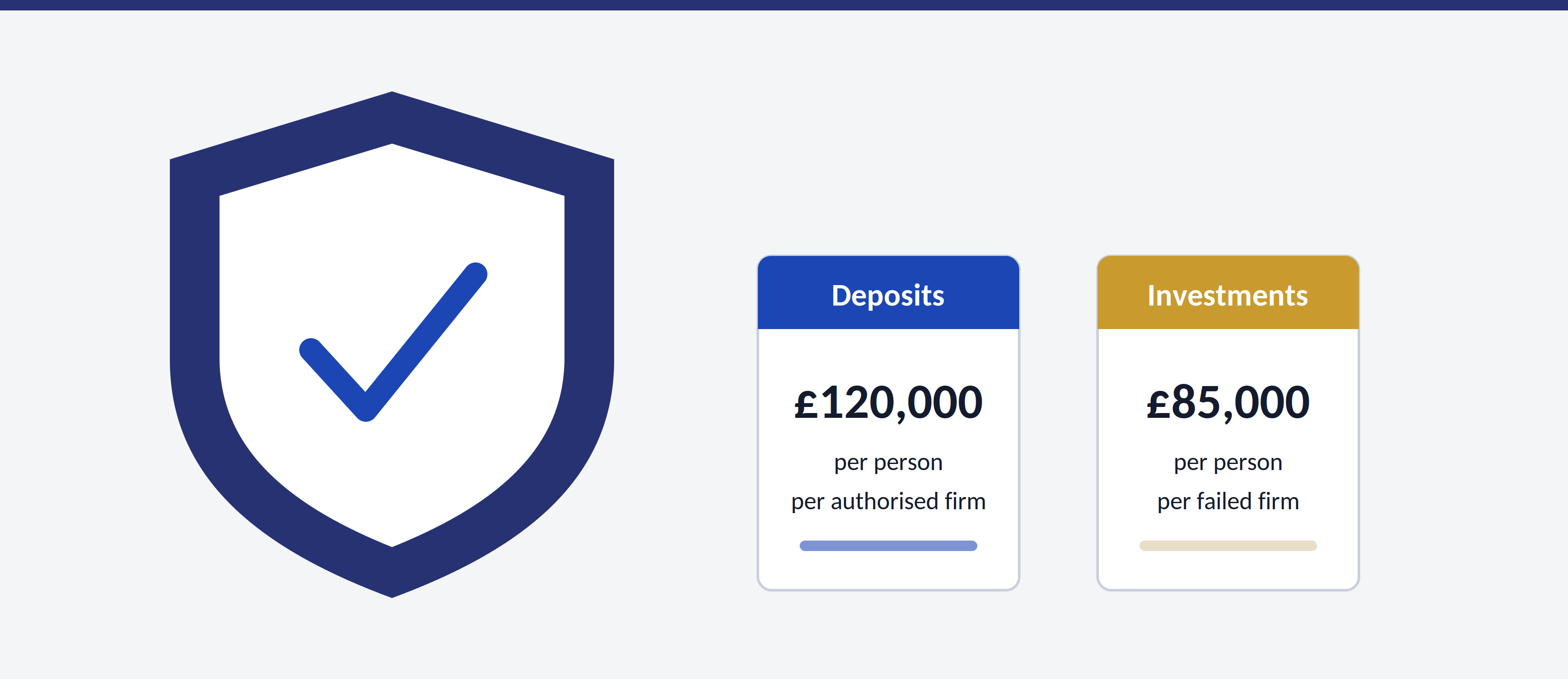
Compensation limits for deposits and investments
The two limits sit under different rulebooks, which is why they diverged. The Prudential Regulation Authority must review the deposit figure at least every five years. It consulted in March 2025 on a rise to £110,000, then landed on £120,000 in policy statement PS24/25 in November 2025 after inflation data and consultation responses pushed it higher. The new figure applies to firm failures occurring on or after 1 December 2025. The previous £85,000 had stood since January 2017.
Investment protection sits under FCA rules and formed no part of that review. It remains £85,000 per eligible person per failed firm.
| Claim type | Limit | Applies from |
|---|---|---|
| Deposits with a bank, building society or credit union | £120,000 per person, per authorised firm | Failures on or after 1 December 2025 |
| Joint account held by two people | £240,000 in total | Failures on or after 1 December 2025 |
| Temporary high balances | £1.4 million, for six months | Failures on or after 1 December 2025 |
| Investment business | £85,000 per person, per firm | Unchanged |
| Ombudsman award, acts from 1 April 2019 | £455,000 | Complaints referred from 1 April 2026 |
| Ombudsman award, acts before 1 April 2019 | £205,000 | Complaints referred from 1 April 2026 |
Deposit compensation arrives without a claim form. The scheme pays eligible depositors automatically and aims to return the money within seven days of the firm going out of business.
One banking licence, several brands
The word carrying the weight is firm, not brand. Where several savings names share a single authorised institution, the limit applies once across everything you hold with that institution rather than to each name separately. Splitting £200,000 across three brands owned by one licence-holder protects £120,000 of it and leaves the rest uncovered.
Which brands share a licence shifts with mergers and acquisitions, so a split that was safe two years ago need not be safe now. The compensation scheme publishes a checker for exactly this question, and it is worth running again after any takeover in the sector.
Temporary high balances and the six-month window
A large sum arriving from a defined life event is covered above the ordinary limit for a limited period. Qualifying events include a property sale, an inheritance, a divorce settlement, an insurance payout and certain redundancy payments. That cover rose to £1.4 million alongside the main increase, and it runs for six months from the date the money becomes yours.
Six months is short. The clock takes no account of whether you have decided what to do with the money, so a purchase that falls through leaves the balance sitting where it is, and protection reverts to the standard limit on the day the window closes.
What the Financial Ombudsman Service can award
The ombudsman handles complaints against firms that are still operating. Complain to the firm first and give it up to eight weeks to respond before the ombudsman will take the case. In broad terms a complaint must be referred within six years of the event, or within three years of the point you reasonably became aware you had cause to complain, whichever gives you longer.
The award limit rises each April in line with the Consumer Prices Index. On 1 April 2026 it reached £455,000 for acts or omissions from 1 April 2019 onwards, and £205,000 for anything earlier. Where the ombudsman considers fair compensation exceeds the ceiling it can recommend the firm pays the balance, but it cannot compel that part.
Using the service costs the complainant nothing. Accepting a decision makes it binding on the firm and closes the matter; rejecting it leaves the courts open. That is the reverse of the sequence most people assume. The same route covers targeted support, which became a regulated activity in April 2026.
The interest change that took effect in January 2026
One mechanical change slipped past most coverage. Compensation for being deprived of your money used to carry simple interest at eight per cent a year. For complaints referred to the ombudsman on or after 1 January 2026 the default rate became the time-weighted Bank of England base rate plus one percentage point, applied on a simple basis. Complaints referred up to 31 December 2025 keep the old rate even where the decision lands later.
Across a claim covering several years the two methods produce materially different numbers, and in every rate environment seen since the change the new one produces less. Where a loss crystallised long ago, the date you refer the complaint now affects the size of the interest element.
Client money and custody before compensation
Compensation is the backstop rather than the first line. Cash held for you by an investment firm belongs in a segregated client money account, and securities should be registered so they are identifiable as yours rather than as assets of the firm. Where segregation has been done properly, a failure is meant to be an administrative event — assets returned or transferred to another provider — and not a compensation event at all.
Claims arise in the gap between that theory and the practice: shortfalls in the pooled client money, records that cannot support a reconciliation, and the cost of the administration itself, which is normally met from the pooled assets before clients are made whole. The compensation scheme covers that shortfall up to the limit. It is one reason the identity of the custodian belongs on the checklist before you commit, as set out on our page about discretionary investment management.
How a claim is actually made
Deposit claims need no action. Where a bank, building society or credit union fails, the compensation scheme pays eligible depositors automatically from the records the firm was required to maintain, and targets seven days.
Investment claims work differently. They start only once the scheme has declared the firm in default, which requires evidence that the firm cannot meet claims against it, and a claim is submitted with documentation showing what you held and what went wrong. Establishing default can take months where the firm's records are incomplete, and the administration of the estate runs in parallel on its own timetable. Interim payments happen where the scheme can quantify part of a claim early.
Claims management companies will offer to do this for a percentage. The scheme is free to use directly, and using it directly leaves the whole recovery with you.
Who is eligible to claim
Eligibility is not universal. Individuals and small businesses are covered. Large companies, most large partnerships and certain institutional claimants are excluded from investment claims, and the tests differ between deposit claims and investment claims. Money held with a firm authorised in another jurisdiction follows that jurisdiction's scheme, with its own limits and its own eligibility rules.
Compensation is assessed per eligible person, so a joint holding is treated as split equally between the holders unless the evidence shows a different split.
Where protection runs out
- Investment losses. A suitable product that lost money because markets fell is covered by nothing, and neither body substitutes for the risk you agreed to take.
- Unregulated products. Activity outside the regulatory perimeter falls outside both schemes, even where the firm selling it was authorised for other things.
- Overseas firms. Protection follows the regulator that authorised the firm, not the country you live in.
- Amounts above the limits. The excess becomes an unsecured claim in the failed firm's estate, which in practice means recovering a fraction of it, years later.
Establishing which side of the perimeter a product sits on is therefore the highest-value check available before any money moves.