
Targeted support is a regulated activity, live since 6 April 2026, that lets an authorised firm holding the relevant permission suggest a course of action to a group of customers in the same defined situation without assessing anyone individually. A firm can tell a segment of customers drawing down a pension at an unsustainable rate that a lower withdrawal rate would leave them better placed, and do it without a fact-find. It is a suggestion built for a segment rather than a recommendation built for you, and the firm has to say so when it gives one.
The category sits between generic information, which anyone may publish, and regulated advice, which requires a full assessment of your circumstances.
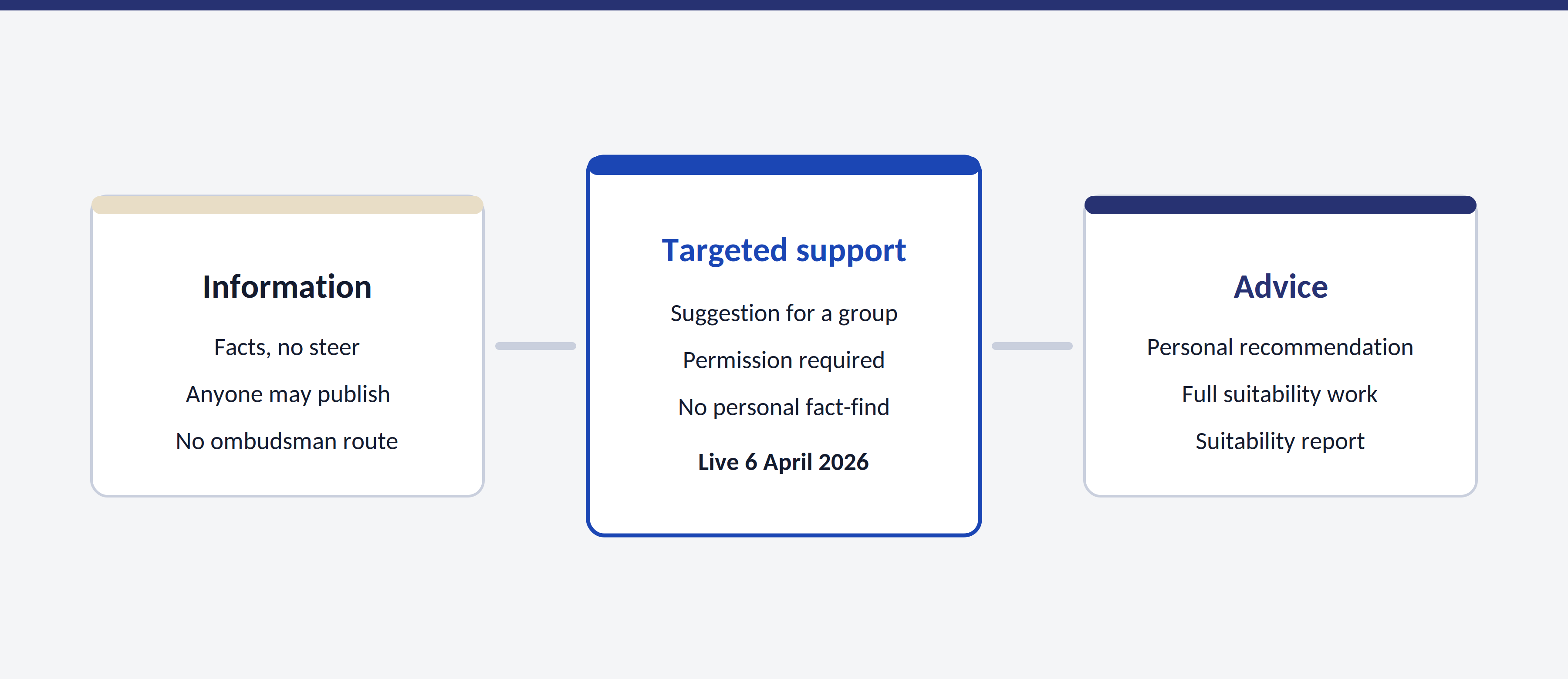
What changed on 6 April 2026
The regime is the main output of the Advice Guidance Boundary Review, a joint Treasury and FCA project addressing what the regulator calls the advice gap. The FCA put the number of underserved consumers at around 23 million. Policy statement PS25/22, carrying the near-final rules, appeared on 11 December 2025; the FCA Board confirmed them as final on 26 February 2026; applications for the new permission opened on 2 March 2026; the rules took effect on 6 April 2026. The framework sits in the Handbook at COBS 9B.
Only authorised firms can provide it, and only with the specific permission, both of which show on the public register. That restriction is the point of the design. The alternative most people were already using was friends, forums and social media, none of which carries any regulatory obligation at all.
How targeted support differs from a personal recommendation
| Feature | Information and guidance | Targeted support | Regulated advice |
|---|---|---|---|
| Regulatory permission needed | No | Yes, a specific one | Yes |
| Basis of what you are told | General facts | Your consumer segment | Your individual circumstances |
| Individual fact-find | None | None | Full |
| Suitability report | No | No | Yes |
| Ombudsman route | Not for unregulated sources | Yes | Yes |
| Cost to you | Usually free | Free or charged | Charged |
The distinction that matters is the direction of travel. Advice starts with you and works outwards to a product. Targeted support starts with a defined group and works inwards to the individuals who fit it. If your circumstances are unusual, being placed in a segment is exactly the wrong outcome, and the design assumes you will notice and seek advice instead.
Situations, consumer segments and the granularity limit
A firm has to define the situations in which it will offer targeted support, then define segments within them: groups sharing that situation and, where relevant, common characteristics. Segments must be specific enough to be useful without amounting to an assessment of one person, and the FCA held that line in the final rules. It added a requirement that a segment must not be designed so it could be read as a comprehensive consideration of an individual's circumstances, while removing earlier guidance about segments being overly individualised.
Mis-segmentation is the obvious failure mode and the rules place it on the firm. The regime is underpinned by the Consumer Duty, and a firm must evidence on a continuing basis that what it is doing puts customers in a better position. That phrase was itself amended during consultation: the FCA moved from "better outcomes" to "better position" to keep the test distinct from the Duty's own language.
What protection comes with targeted support
- It must be labelled. The firm has to tell you that what you are receiving is targeted support, and explain which segment you were allocated to.
- The information must be given in a durable medium at the time, or as soon as reasonably practicable afterwards.
- Product governance rules apply, so anything the suggestion points at still has to be designed for the market it is aimed at.
- Complaints follow the normal route through the firm and then the ombudsman, on the limits set out under investor protection when a firm fails.
- Appointed representatives cannot deliver it. The industry asked for that concession and did not get it.
- It cannot be used in relation to safeguarded pension benefits.
Annuities ended up treated more flexibly than first proposed. The original draft barred firms from quoting or recommending specific annuities and imposed a mandatory break before an annuity sale could continue. The final rules relaxed that, allowing firms to direct consumers towards whole-of-market annuity brokerages.
Charging, cross-subsidy and the incentive question
Firms may charge for targeted support or provide it free. The FCA expects many to offer it at no cost and fund it in other ways, and it explicitly permits a degree of cross-subsidy. That settles a long-running problem about how non-advice help gets paid for, and it opens a question worth holding onto.
A suggestion that costs you nothing is still made by a firm earning money somewhere. The segment you land in determines what you are shown, and what you are shown determines what you buy. Asking which products sit behind a free suggestion, and who manufactures them, is a reasonable question rather than a cynical one.
Signposting and how firms may promote it
Targeted support was not built to sit quietly on a website. Under the consequential Handbook changes consulted on in CP25/26, firms subject to the relevant pension communication rules are expected to present targeted support with equal prominence alongside signposting to guidance and to advice, so consumers see the full range of help available. A firm running its own service may point to that alongside the public guidance body.
Promotion runs straight into data protection law, because an offer of targeted support directed at a named customer looks a great deal like direct marketing. The FCA published a joint statement with the Information Commissioner's Office addressing that overlap, and the government confirmed secondary legislation letting workplace pension providers send targeted support communications to members who have not opted out of direct marketing.
What targeted support cannot do
The scope is deliberately narrow. Targeted support applies to pensions and retail investments, and to nothing else — mortgages, protection insurance and general insurance sit outside it. Safeguarded pension benefits are excluded outright. Appointed representatives cannot deliver it at all, which removes a large slice of the adviser market from the regime on day one.
Nor does it produce a decision you can lean on. There is no suitability report, no record that anyone considered your circumstances, and no assessment of whether the suggestion fits the money you actually hold. If the segment you were placed in was wrong for you, the failure is the firm's to answer for, but the loss is still yours to carry while that is established.
Where circumstances are unusual — a business sale, a divorce, an overseas element, a portfolio built around a single legacy holding — the segment model has nothing to offer, and the honest answer is advice.
What is still being consulted on
Targeted support was never meant to be the whole answer. In March 2026 the FCA published CP26/10, proposing to simplify its investment advice rules so firms feel able to offer focused, lower-cost advice and more flexible ongoing services. That consultation closed on 22 May 2026 and a policy statement is expected in the fourth quarter of 2026.
Two further strands sit alongside it. The FCA has said it will publish consolidated perimeter guidance clarifying where advice begins, and a discussion paper on guided retirement was expected during 2026, subject to the pensions legislation. Anyone weighing whether to pay for advice now or wait should expect the position to have moved again by the end of the year.
Targeted support does not settle who holds and runs the money. Where a suggestion ends with you invested, the service models are compared on our page about discretionary investment management.